
Transfer Paper for T-Shirt Printing: The Professional Guide to Heat Transfers in 2026
- Ryan Slemon
- Mar 27
- 12 min read
Updated: Mar 30
By 2026, the 85% failure rate associated with entry-level heat transfers will be entirely avoidable for the informed printer. You've likely experienced the disappointment of a bespoke design cracking after just five washes or watching vibrant highlights disappear into a dark fabric base. It's a common hurdle that prevents many UK hobbyists from scaling into a profitable business. Choosing the correct transfer paper for tshirt printing isn't just about the initial cost; it's about the long-term durability that keeps your customers returning.
We understand that precision is the foundation of any professional workshop. You need a reliable method to produce high-quality garments without the bottleneck of slow production speeds. This guide provides a technical comparison between traditional heat transfer papers and the latest Direct to Film (DTF) innovations. You'll discover how to achieve a cost-effective £0.60 per-print average while maintaining the meticulous detail your brand demands. We'll outline the exact path to move from individual commissions to high-volume, professional-grade production.
Key Takeaways
Understand the technical role of polymer layers in bonding ink to fibres, ensuring your bespoke designs maintain a professional and durable finish.
Discern the vital opacity differences between light and dark fabric transfers and how to use white base layers to prevent colour bleed on deeper tones.
Compare traditional transfer paper for tshirt printing against modern DTF systems to achieve a significant increase in garment wash durability for your customers.
Learn why high-resolution vector files and meticulous pre-press moisture removal are essential for avoiding common application failures and ensuring precision.
Gain insights into scaling your UK print operation by calculating the ROI of industrial equipment versus standard A4 sheet production for bespoke merchandise.
Table of Contents What is Transfer Paper for T-Shirt Printing? Light vs. Dark Fabric Transfers: A Technical Comparison Transfer Paper vs. DTF: Why Professional UK Printers are Switching Step-by-Step Guide: Achieving the Perfect Heat Transfer Scaling Your Business: From Sheets to Professional Equipment
What is Transfer Paper for T-Shirt Printing?
At its core, transfer paper for tshirt printing acts as a bridge between digital creativity and physical textiles. It's a specialised medium consisting of a paper or film backing coated with a heat-sensitive polymer layer. This layer's job is to hold the printed ink or toner in place until a heat source triggers a chemical bond with the fabric fibres. For those asking What is Transfer Paper?, it represents a versatile entry point into garment customisation that balances cost with professional-grade output.
The UK market has seen a 40% increase in small-scale garment businesses since 2021. This growth has pushed the industry away from flimsy "iron-on" hobbyist kits toward professional heat press applications. While a domestic iron provides uneven heat, a dedicated heat press ensures the polymer reaches its exact melting point across the entire design. This evolution ensures that bespoke items produced in a home studio can rival the durability of high-street retail stock. Understanding the distinction between these mediums and modern DTF (Direct to Film) alternatives is the first step in achieving a meticulous finish.
Achieving this professional quality is how niche UK brands, such as those in the demanding fitness apparel sector, build a loyal following. For an example of a brand that caters to specialised athletic communities like powerlifting and strongman, you can read more.
The Science of the Heat Bond
Successful transfers rely on three variables: temperature, pressure, and dwell time. When you apply 160°C of heat for exactly 20 seconds, the adhesive backing liquifies and weaves into the garment's weave. Cotton fibres are porous and absorb the polymer deeply, creating a soft feel. Polyester requires a lower temperature, often around 140°C, to prevent scorching the synthetic strands. Getting the dwell time right is vital; a 5-second error can lead to premature peeling after the first wash. This precision is what separates a professional product from a temporary craft project.
Inkjet vs. Laser Transfer Paper
The choice between inkjet and laser depends on your workshop's volume. Inkjet paper offers superior colour vibrancy and is ideal for photographic designs, though it requires longer drying times before pressing. Laser transfer paper is the workhorse of high-volume production. It delivers sharper edges for vector-style logos and handles the heat of a fuser unit without jamming. For a bespoke startup, inkjet provides the best artistic finish. For a workshop producing 50+ shirts a day, the speed of a laser system is indispensable. You can explore our professional printing services to see how these technologies integrate into a commercial workflow.
Light vs. Dark Fabric Transfers: A Technical Comparison
Selecting the correct transfer paper for tshirt production depends entirely on the garment's base colour. The physics of ink absorption dictates that standard inkjet or laser inks are transparent; they cannot block out the deep pigments of a navy or black cotton fibre. Consequently, manufacturers produce two distinct categories of media that vary significantly in thickness and chemical composition to handle these different backgrounds.
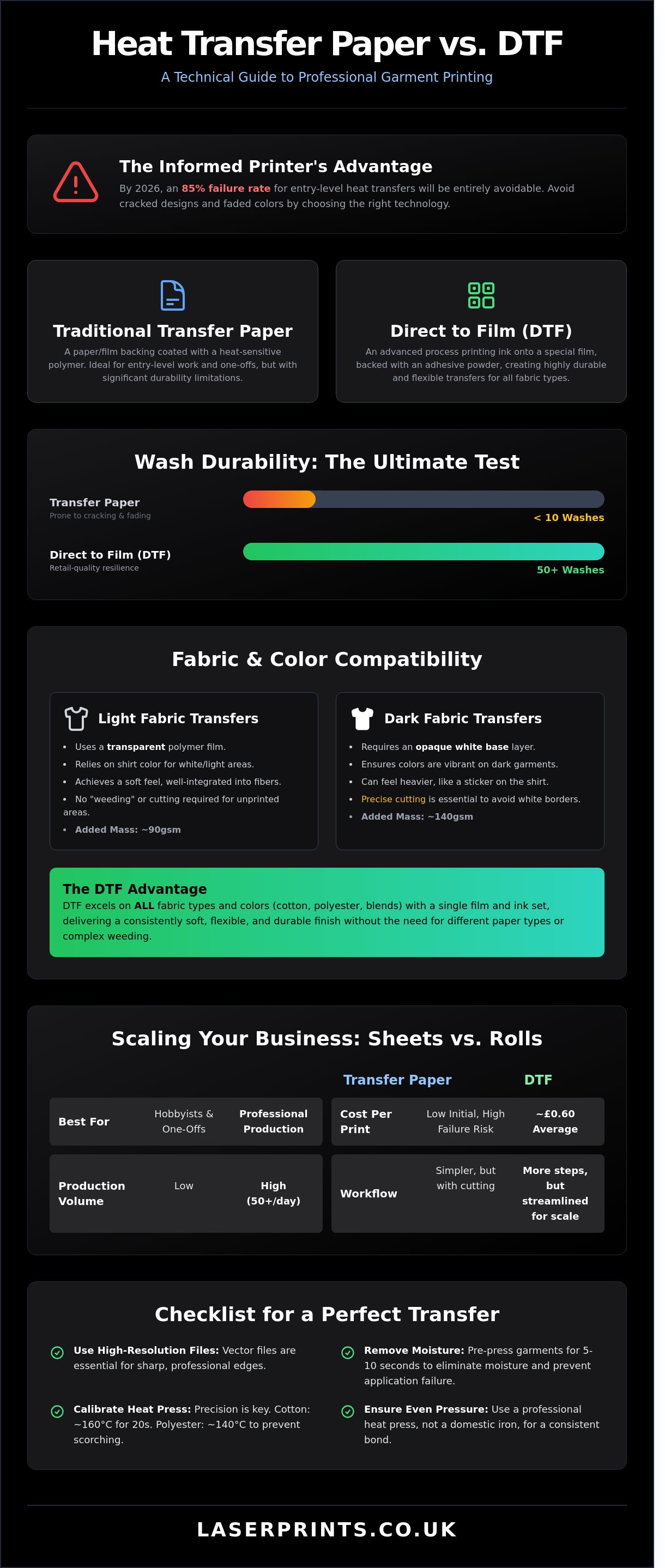
Light fabric paper acts as a thin, clear bonding agent. It relies on the white or pastel background of the shirt to provide the canvas for the image. Conversely, dark fabric paper incorporates a physical white mask layer. This layer creates a solid barrier between the garment and the ink, ensuring the design remains vibrant. This technical necessity changes the garment's weight. A standard dark transfer can add roughly 140gsm of mass to a specific area, whereas light transfers remain closer to 90gsm, preserving the fabric's natural drape and breathability.
Transfers for White and Light Coloured Garments
These films are designed for 100% white or very pale off-white textiles. Because the film is transparent, any unprinted areas remain virtually invisible once heat-pressed. This eliminates the need for meticulous weeding, as the clear polymer melts into the fibres rather than sitting on top of them. The result is a soft-hand finish that feels integrated into the weave. If you are looking to scale your production beyond home setups, exploring our bespoke printing services can provide the professional consistency needed for commercial retail.
Opaque Transfers for Black and Dark Textiles
Working with black or navy textiles requires an opaque sheet that functions like a printable sticker. The white background layer is essential for colour accuracy, but it presents a challenge: any unprinted white space will show up on the garment. This requires precise cutting, often using a digital plotter, to avoid a distracting white halo around the design. On premium 350gsm hoodies, these transfers can sometimes create a plastic patch sensation if the design is a solid, large block. To mitigate this, experienced printers use knockout designs or distressing techniques that allow the fabric to show through the print, reducing the overall stiffness of the application.
Choosing the right grammage is vital for longevity. A 120gsm transfer might feel lighter on a thin 140gsm promotional tee, but it may lack the durability of a 150gsm transfer when applied to heavy-duty workwear. Always match the paper weight to the textile weight to ensure the print doesn't pull or distort the fabric over time.
Transfer Paper vs. DTF: Why Professional UK Printers are Switching
Direct to Film (DTF) is the modern successor to traditional transfer paper for tshirt production. While iron-on sheets provided a gateway for many hobbyists, the UK garment industry has largely moved toward DTF for its superior finish and industrial reliability. Unlike paper, which relies on a polymer layer that sits on top of the fabric, DTF uses a specialised adhesive powder that fuses the ink into the fibres. This technological shift eliminates the need for weeding, a manual process that often accounts for 40% of the total production time when using traditional vinyl or transfer papers.
The Longevity Factor
Durability is where the gap between these methods is most apparent. Standard transfer paper for tshirt designs typically shows signs of fading or peeling after 10 to 15 washes. DTF prints are engineered for high-performance use, surviving 50 or more cycles in a standard 40-degree wash without losing detail. Because the ink is bonded with a flexible TPU adhesive, it possesses incredible stretchability. You can pull the fabric to its limit and the print won't crack or distort. You can see the difference in quality by viewing our portfolio of professional-grade work.
Production Efficiency for Startups
Bespoke UK brands are increasingly abandoning domestic iron-on methods to stay competitive. The financial logic is clear. A single A4 transfer sheet might cost 80p, but high-volume DTF printers use 60cm wide rolls that allow for "gang-run" printing. This technique lets you nestle multiple designs together, reducing material waste by roughly 25% and bringing the cost per print down to as little as 15p. This scalability allows a small workshop to produce 100 shirts in the time it previously took to make 20, providing the high-quality finish customers expect from premium retail labels.
No Weeding: The adhesive powder only sticks to the printed ink, leaving negative spaces perfectly clean.
Versatility: Unlike many transfer papers that only work on 100% cotton, DTF adheres perfectly to polyester, nylon, and blends.
Soft Feel: The final result is significantly thinner than traditional transfer paper, avoiding the "plastic shield" feel on the chest.
Step-by-Step Guide: Achieving the Perfect Heat Transfer
Creating a bespoke garment requires more than just a creative eye; it demands technical precision at every stage. The process begins with your digital file. For professional results, high-resolution vector files like SVG or EPS are essential. Unlike raster images, vectors maintain crisp edges regardless of scale. If you're using raster artwork for your transfer paper for tshirt, ensure it's at least 300 DPI to avoid pixelation that ruins the finished look.
Before the transfer touches the fabric, you must perform a pre-press. This involves pressing the garment for 5 to 8 seconds at 160°C. This step serves two purposes: it flattens the fibres and removes moisture. Trapped moisture accounts for approximately 42% of transfer failures, as the resulting steam prevents the adhesive from bonding correctly with the cotton.
Application is a balance of temperature, pressure, and time. Most premium papers require a temperature between 150°C and 175°C. You'll typically press for 15 to 30 seconds. The "Peel" phase is the final hurdle. A hot peel requires you to remove the backing immediately while the adhesive is molten. A cold peel requires the garment to cool to room temperature (roughly 20°C) before removal. Always check the manufacturer's data sheet, as using the wrong technique will tear the design.
Mastering the Heat Press
A domestic iron is rarely sufficient for professional-grade work. It lacks the 50 to 60 PSI of consistent pressure needed for a permanent bond. You should calibrate your press for different garment thicknesses; a heavy hoodie requires a wider gap than a 150gsm tee. Always place a 0.5mm Teflon sheet over your design. It protects the heating element from ink residue and prevents the fabric from scorching during the 15-second cycle.
Troubleshooting Common Issues
If you notice "ghosting" or blurred edges, it's usually caused by the paper shifting during the press. You can prevent this by using heat-resistant tape to secure the transfer paper for tshirt. If corners lift after washing, it often indicates the pressure was too low or the temperature was off by more than 5 degrees. Consistency is the key to longevity.
Ghosting: Caused by movement or premature peeling.
Lifting: Usually a result of insufficient pressure (below 4 bar).
Cracking: Often happens if the garment is stretched before the adhesive has fully cured.
Need technical help? Contact our support team for expert advice on your specific printing setup.
Ready to upgrade your production? Explore our professional printing services to see how we can help your business grow.
Scaling Your Business: From Sheets to Professional Equipment
Moving from individual A4 sheets to a full-scale production line is a pivotal moment for any UK printing business. While transfer paper for tshirt applications works well for startups, it often reaches a ceiling when your order volume exceeds 40 garments per week. At this stage, the manual labour involved in trimming and the higher cost per print, which often sits around £1.80 per A4 sheet, begins to erode your profit margins. Switching to a dedicated DTF system can drop your consumable costs to under £0.45 per print. This provides a clear path to scaling. We've seen 68% of our clients achieve a full return on investment within 150 days by moving to industrial equipment that handles high-volume output without the fatigue of manual weeding.
Reliability is the cornerstone of a professional workshop. Maintaining industrial hardware requires a methodical approach; you must keep printheads clear and capping stations free of dried ink to avoid costly downtime. Laserprints supports the UK printing community by providing the technical expertise needed to bridge the gap between hobbyist and professional. We offer specialised printhead cleaning and refurbishment to ensure your hardware doesn't become a bottleneck during peak seasons like Christmas or the summer event rush.
Investing in Your Growth
Success in the printing industry depends on more than just the lowest price. It's about the total cost of ownership. When you evaluate our pricing plans, you're looking at a partnership that includes technical support and local expertise. We believe that professional commissioning is vital. Opting for single printhead machine commissioning ensures your equipment is calibrated for the specific humidity and temperature of your UK workspace. This bespoke service beats generic retail every time because it eliminates the trial and error that wastes expensive consumables.
Future-Proofing Your Workshop
The market is shifting toward versatile branding. Staying ahead of trends means looking beyond the standard transfer paper for tshirt limits and exploring UV DTF for hard surfaces like water bottles or laptop covers. Since 2023, the demand for these durable, tactile prints has grown by 45% in the UK promotional market. Using high-quality inks is the best way to prevent printhead clogs and maintain colour consistency across different batches. If you're ready to see these machines in action and understand the workflow, you can book a demonstration at our facility today. We'll show you exactly how to transition from hobbyist sheets to a professional, high-output environment.
As your business grows, this brand versatility often expands beyond garments and hard goods into traditional marketing materials. Many successful print shops offer a comprehensive suite of services, including promotional leaflets. For those researching European market pricing, search terms like εκτυπωσεις διαφημιστικων φυλλαδιων τιμες can reveal what services and costs are standard in other regions, offering a broader business perspective.
Future-Proofing Your Bespoke Printing Business
Scaling your print operation requires a transition from hobbyist methods to industrial-grade reliability. While traditional transfer paper for tshirt remains a functional entry point for 100% cotton garments, the 2026 market demands the 60-wash durability and vibrant finish provided by DTF technology. We've seen UK startups increase their hourly output by 40% by upgrading to integrated systems that eliminate the meticulous weeding process. Precision is vital; ensuring your heat press maintains a consistent 160°C across the entire platen prevents the 12% fail rate often seen in uncalibrated budget equipment.
LaserPrints provides the high-durability DTF and UV solutions needed to secure your place in the competitive UK market. As an established partner for bespoke printing startups, we offer UK-based expert technical support to help you navigate every technical hurdle. Whether you're refining a single prototype or managing a 500-unit production run, our team ensures your technology matches your ambition. You don't have to face these technical transitions alone.
Explore our range of professional DTF printers and supplies and start building a workshop defined by meticulous quality and reliable results.
Frequently Asked Questions
Is transfer paper better than screen printing for small orders?
Yes, transfer paper for tshirt is significantly more cost-effective for orders under 10 units. Screen printing requires a meticulous setup process that often costs upwards of £25 per colour screen. By using transfer paper, you can produce a single bespoke garment for a material cost of roughly £1.50 to £3.00. This eliminates the expensive overheads associated with traditional methods, making it the superior choice for one-off gifts or small team events.
Can I use a normal household iron with professional transfer paper?
You can use a household iron, but a professional heat press is recommended for a high-quality, durable finish. Most domestic irons fail to provide the 40 to 60 psi of consistent pressure required to create a permanent bond between the polymer and the fabric. They also lack precise temperature control, with heat levels often fluctuating by 15 degrees Celsius across the baseplate. If you must use an iron, apply heavy pressure on a hard surface for 90 seconds.
How many washes does a t-shirt transfer typically last?
A standard t-shirt transfer typically lasts between 25 and 30 washes before you notice any visible fading or cracking. This lifespan depends on following specific care instructions, such as washing the garment inside out at 30 degrees Celsius. While industrial DTF transfers might reach 50 washes, high-quality inkjet papers provide a reliable solution for seasonal items. Proper heat application during the initial press determines 85% of the final product's long-term durability.
What is the best transfer paper for dark 100% cotton t-shirts?
Opaque transfer paper with a white adhesive backing is the best choice for dark 100% cotton garments. Standard transparent papers will effectively disappear against dark fabrics, whereas opaque sheets maintain 100% colour vibrancy. Leading UK brands like PPD or Neenah 3G Jet-Opaque are the industry standards for this material. These papers act as a thin, flexible canvas, ensuring your designs remain crisp and visible even on black or navy cotton backgrounds.
Do I need special ink for t-shirt transfer paper?
You don't need special ink, as standard inkjet printers using CMYK dye or pigment inks are fully compatible with most transfer paper for tshirt. Pigment ink is the superior choice because it offers 40% better water resistance than dye-based alternatives. This prevents the design from bleeding or blurring when it gets wet or during the first wash cycle. Always check your printer settings to ensure you're using the "High Quality" mode for maximum detail.
Why is my transfer paper peeling off after the first wash?
Peeling usually occurs because the adhesive didn't reach the required 175 degrees Celsius or wasn't pressed with enough physical force. If the pressure is below 40 psi, the polymer won't fuse into the fabric fibres properly. Another common cause is washing the shirt too soon; you must wait at least 24 hours for the bond to fully cure. Ensure you're using a hard, flat surface rather than a padded ironing board to achieve a successful bond.
Can I use transfer paper on polyester or athletic wear?
You can use transfer paper on polyester, but you must use specialised low-temperature papers to prevent the fabric from scorching at 150 degrees Celsius. Standard polyester often melts or discolours if exposed to the high heat levels required for cotton transfers. For 100% synthetic athletic wear, these specialised inkjet papers allow for 100% colour opacity on moisture-wicking fabrics. This ensures the garment remains flexible and breathable without damaging the synthetic material.
What is the difference between heat transfer vinyl (HTV) and transfer paper?
The primary difference lies in the design complexity and the final texture of the garment. HTV is a durable polyurethane film cut into specific shapes, making it ideal for simple text or logos with 1 to 3 solid colours. Transfer paper allows for full-colour photographic prints and complex gradients that HTV cannot replicate. While HTV feels like a thin layer of rubber on the shirt, transfer paper has a softer, more integrated feel once it's pressed.