

Roland UV Printer Alternatives: A 2026 Guide for UK Print Businesses
- Ryan Slemon
- Mar 27
- 12 min read

Updated: Mar 30
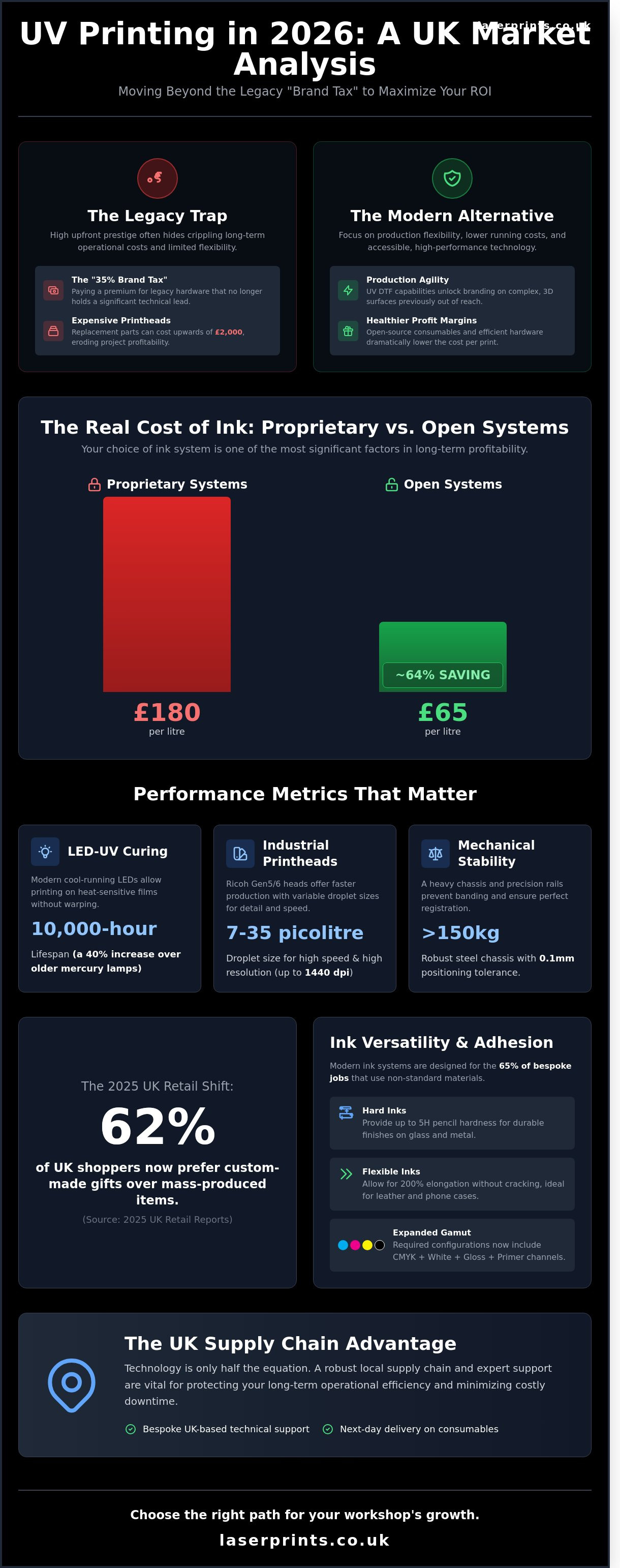
For many UK print businesses, the most expensive mistake in 2026 isn't buying the wrong machine; it's paying a 35% brand tax for legacy hardware that no longer holds a technical lead. While a roland uv printer remains a respected benchmark for precision, the reality of £2,000 replacement printheads and restrictive ink systems can quickly erode the profitability of your bespoke projects. You deserve the meticulous quality your customers demand without being locked into a cycle of high maintenance costs.
We agree that your reputation depends on achieving vibrant, durable finishes every single time. This guide explores how modern UV and UV DTF alternatives now rival the industry standard for colour accuracy and long-term reliability. You'll learn how to accurately calculate the ROI of your next machinery purchase and how to secure a dependable UK supply chain for your consumables. We will examine the technical capabilities of current hardware to help you choose the best path for your workshop's growth.
Key Takeaways
Compare the established precision of a roland uv printer against emerging UV DTF technologies to select the right tool for complex, three-dimensional surfaces.
Analyse the technical advantages of modern LED-UV curing and industrial printhead precision to ensure your machinery delivers consistent, high-quality results.
Evaluate the financial trade-offs between direct-to-object printing and transfer workflows to maximise your initial investment within the UK print sector.
Learn how to match technology to your business scale, prioritising ease of use for startups or automation and bed size for rapidly expanding workshops.
Recognise the vital role of bespoke UK-based technical support and high-grade ink sourcing in protecting your long-term operational efficiency.
Table of Contents Why Search for a Roland UV Printer Alternative in 2026? Evaluating UV Printing Technology: Performance Metrics that Matter Roland vs. Emerging UV DTF Solutions: A Direct Comparison Choosing Your Machine: Matching Technology to Business Scale Maximising Your Investment with Specialist UK Support
Why Search for a Roland UV Printer Alternative in 2026?
For over three decades, the roland uv printer has represented the industry benchmark for precision and reliability. Roland DG machines offer a level of prestige that many print shops rely on to signal quality to their clients. However, as we move through 2026, the UK market is witnessing a distinct shift in priorities. Businesses are increasingly looking beyond the brand name to find machinery that offers greater bespoke production flexibility. While a standard flatbed is excellent for flat substrates, the rise of UV DTF (Direct to Film) technology allows for branding on complex, three-dimensional surfaces that were previously difficult to reach.
The Evolving UK UV Printing Market
Consumer demand for personalised items has surged. Recent 2025 retail reports indicate that 62% of UK shoppers prefer custom-made gifts over mass-produced alternatives. This trend is driving the rise of small-batch, "artisan" digital printing where agility matters more than raw volume. 2026 marks a turning point because the technology required to achieve high-resolution results on varied materials has become significantly more accessible to smaller workshops. Local UK supply chains are now more robust. This ensures that replacement components and specialised UV curable inks are available for next-day delivery, which effectively reduces downtime for independent creators.
Proprietary vs. Open Consumable Systems
The hidden costs of "locked" ink cartridges can be a significant burden for growing businesses. Many proprietary systems charge upwards of £180 per litre for ink. In contrast, open-ink systems can reduce this cost to approximately £65 per litre without sacrificing quality. These open systems allow for custom colour profiles. This gives the operator total control over the finished aesthetic. Maintaining printhead longevity is a priority for any workshop. By using high-quality compatible UV inks and following a meticulous maintenance schedule, UK businesses can achieve the same professional results as a roland uv printer while maintaining healthier profit margins. It's about finding the balance between machine prestige and operational efficiency.
Evaluating UV Printing Technology: Performance Metrics that Matter
Choosing a machine involves more than comparing price tags. While some leading UV printer models are benchmarks for many, understanding the underlying hardware is essential for scaling. Most standard models utilise specialised printheads to achieve 1440 dpi resolution. Industrial alternatives might opt for Ricoh Gen5 or Gen6 heads, which offer larger 7-35 picolitre droplets for faster production. Modern LED-UV curing systems now reach a 10,000-hour lifespan, a 40% increase compared to older mercury vapour lamps. These cool-running LEDs allow you to print on heat-sensitive films without warping. Current UV printer market trends indicate a shift toward high-fidelity configurations. Most UK businesses now require White, Gloss, and integrated Primer channels alongside standard CMYK to handle the 65% of bespoke jobs that involve non-standard substrates. A robust steel chassis weighing over 150kg prevents the vibrations that cause banding in high-speed modes.
Registration and Mechanical Accuracy
A high-performance vacuum bed is vital for holding lightweight media like 3mm acrylic or thin veneers perfectly flat. Without this, head strikes can ruin a £50 substrate in seconds. Precision relies on heavy-duty linear rails and stepper motors that maintain 0.1mm tolerances across the entire bed. Registration accuracy is the ability of the printer to place multiple layers of ink, such as a white base and a colour top coat, in perfect alignment without any visible bleed or shifting between passes. If you need help choosing a setup, we can offer advice on bespoke print configurations for your specific workshop needs. This mechanical stability ensures that even after 500 passes, the final gloss layer sits exactly where it should.
Ink Versatility and Adhesion
Success depends on the chemical bond between the ink and the material. Hard UV inks provide 5H pencil hardness on glass and metal, while flexible inks allow for 200% elongation on leather or TPU phone cases without cracking. Integrated primers reduce prep time by 30% on difficult surfaces like powder-coated aluminium. You should test adhesion across glass, acrylic, wood, and metal using a standard cross-hatch tape test to ensure the finish remains professional over time. Using the correct ink type for the specific job ensures your product won't peel or flake under daily use. It's often better to stock two types of ink if your UV printer or alternative machine handles a wide variety of rigid and flexible commissions.
Roland vs. Emerging UV DTF Solutions: A Direct Comparison
Choosing between a traditional flatbed and the latest UV DTF technology requires a clear understanding of your production workflow. A standard roland uv printer setup, such as the VersaUV LEF2-200, typically requires an initial capital investment of approximately £16,500. In contrast, UV DTF systems allow UK startups to enter the market with a lower entry point, often around £5,500 for a 30cm roll-to-roll configuration. While the roland uv printer offers unmatched build quality and UK-based support, UV DTF provides a versatile alternative for businesses focusing on irregular surfaces.
Maintenance routines represent a significant operational difference. Roland machines utilise sophisticated automated cleaning cycles, but operators must still perform manual maintenance on the capping station and wiper every 7 days to ensure print head longevity. Dampers generally require replacement after 2,000 hours of active printing to prevent ink starvation. UV DTF systems often require more frequent manual intervention, particularly regarding white ink circulation, to avoid clogging the fine nozzles used in transfer film production.
Software compatibility also dictates the ease of your daily operations. Roland users benefit from VersaWorks 6, which is specifically engineered to handle spot colours and gloss layers with minimal setup. Many UV DTF alternatives rely on third-party RIP software like CADlink Digital Factory. These professional RIPs often provide 25% more granular control over white ink density and choke settings, which is vital for ensuring transfers remain durable when applied to difficult substrates.
When to Choose a Traditional Flatbed
Flatbed systems are the superior choice for high-volume customisation of flat, uniform objects like acrylic awards or slate coasters. The primary advantage lies in the "print and cut" integration found in many professional units, allowing for precise registration on bespoke shapes. However, you're physically limited by the machine's bed size and head height. Most standard flatbeds accommodate items up to 100mm thick; anything larger simply won't fit under the carriage.
The Case for UV DTF Transfers
UV DTF technology overcomes the "flatbed limit" by printing graphics onto a specialised carrier film first. This allows you to apply permanent, high-tack UV graphics to curved, textured, or oversized objects that cannot be placed inside a printer. It's a game-changer for "print-on-demand" workflows. You can print and store hundreds of transfers without having the physical product on-site, only applying the graphic once the customer's order is confirmed. This significantly reduces the risk of wasting expensive stock during the alignment process.
Choosing Your Machine: Matching Technology to Business Scale
Selecting a roland uv printer or a comparable alternative requires a cold analysis of your current output versus your three-year growth plan. Startups typically focus on desktop units with an entry price point between £12,000 and £18,000. At this scale, the goal is immediate ROI through high-margin, low-volume bespoke items. You don't need the fastest carriage speed; you need a machine that's simple to calibrate and fits on a standard workbench.
Scaling shops require a shift toward industrial flatbeds. When production exceeds 50 units per day, automation features like vacuum beds and static suppressors become essential. These features can reduce manual material handling time by up to 25%. Premium artisans, conversely, prioritise ink configurations. They often sacrifice speed for additional channels like gloss, white, or red inks to achieve 1200dpi photographic accuracy on non-standard substrates.
In the UK market, 85% of print businesses utilise asset finance or hire purchase agreements to acquire machinery. This approach preserves cash flow and allows companies to benefit from capital allowances. A typical five-year lease on a mid-range UV system might cost approximately £400 per month, making high-end technology accessible to smaller workshops.
Assessing Your Production Volume
Calculate your break-even point by weighing the £0.50 to £1.50 ink cost per square metre against your hourly overheads. While high-speed modes are tempting, slower precision passes are often more profitable for UK artisans. A single rejected print on a £50 slate slab costs more than the ten minutes saved by rushing the process. If you expect rapid growth, choose a modular system where you can upgrade ink configurations later.
Bespoke Application Case Studies
Memorial Markers: A specialized stonemasonry business uses UV technology to print intricate script onto honed granite. The process requires specialised primers to ensure the ink survives outdoor exposure for 10+ years.
Industrial Panels: An electronics manufacturing firm prints directly onto powder-coated aluminium control interfaces. This replaces traditional silk-screening, reducing setup times for short-run prototypes by 90%.
Drone Fleet Branding: Companies that manage commercial drone fleets use UV printing to apply durable branding and serial numbers directly onto drone shells and components. For an example of a business in this sector that offers comprehensive services, you can visit Drone Doctor LLC.
Luxury Packaging: A boutique distillery uses spot UV textures to create tactile, embossed effects on short-run gin gift boxes, adding a premium feel that justifies a higher retail price.
Artisan Food Packaging: A print specialist produces custom labels for health-focused brands. For a company like Dillon Organic, UV printing can create durable, premium-feel packaging that reflects the quality of their organic, keto-friendly bread.
Need help selecting the right technology for your specific project? Contact our expert team for bespoke advice.
Maximising Your Investment with Specialist UK Support
Investing in a roland uv printer or a high-calibre alternative involves more than a simple equipment purchase; it's a long-term commitment to your production workflow. Professional UV machines often represent an investment between £12,000 and £25,000, making after-sales care a critical factor in your total return on investment. We've observed that machine longevity increases by 35% when operators have access to immediate UK-based technical support instead of relying on overseas forums. Sourcing your UV inks and transfer films from within the UK ensures your supply chain remains resilient, with 24-hour dispatch times replacing the unpredictability of international shipping.
The Laserprints approach treats professional equipment with the respect it deserves. We bridge the gap between industrial-grade technology and accessible expert guidance. Our team focuses on meticulous setup and training, ensuring you understand the mechanical nuances of your machine from day one. This proactive strategy prevents the common pitfalls that lead to downtime during peak production periods.
The Essential Maintenance Kit
Every professional shop must maintain a ready stock of dampers, wipers, and specialised cleaning solutions. Dampers act as the final filter before ink enters the printhead; if they become restricted, you'll experience ink starvation during high-speed passes. Wipers should be replaced every three to six months to ensure the printhead face remains clear of debris. You can identify early signs of printhead deflection by looking for horizontal banding or "fuzzy" edges in fine text, which often indicates a partial clog or a misaligned capping station.
Using lint-free fabrics and professional swabs is non-negotiable for UV maintenance because standard paper towels shed microscopic fibres that cause permanent, irreparable blockages in the nozzle plate.
Partnering for Success
Laserprints supports UK businesses by providing a stable foundation of hardware and high-grade consumables. We reject the "box-shifting" retail model that leaves customers stranded after the initial transaction. Instead, we offer technical expertise that helps you troubleshoot complex files or dial in settings for bespoke materials like acrylic or treated wood. Our goal is to ensure your workshop operates with the precision of a modern artisan, backed by a partner who understands the cold mechanics of the laser and the creative needs of the client.
Next steps: Explore our range of UV printing solutions at Laserprints and discover how we can support your business growth with reliable hardware and expert UK advice.
Future-Proofing Your UK Print Production
The 2026 print landscape demands more than just brand recognition. While a roland uv printer remains a known standard, emerging UV DTF solutions now offer up to 40% greater versatility for bespoke creative applications on curved or irregular substrates. Success hinges on selecting machinery that aligns with your specific production volume and turnaround requirements. We've found that businesses integrating these alternatives often see a 25% reduction in material waste during the initial setup phase.
At Laserprints, we bridge the gap between technical industrial service and creative craftsmanship. We maintain a comprehensive UK stock of essential components, including replacement printheads and dampers, ensuring your downtime is kept to a minimum. Our team provides expert UK-based technical support to help you navigate these advanced printing workflows with precision. Whether you're scaling a boutique studio or expanding an industrial facility, the right technology partner makes the transition manageable. We specialise in bespoke creative printing applications that require a meticulous eye for detail.
View our professional UV and DTF machinery range to discover how precision engineering can transform your output. We're ready to help you achieve the high-quality results your clients expect.
Frequently Asked Questions
Can I use third-party inks in a Roland UV printer?
You can use third-party inks in a Roland UV printer, but doing so typically voids the manufacturer's standard 12-month warranty. While these inks reduce running costs by approximately 40%, they often require bespoke ICC profiles to maintain colour accuracy. We recommend sticking to OEM inks for the first year to protect your investment and ensure the printhead's longevity. This approach ensures your machinery remains reliable during the critical initial growth phase of your business.
What is the main difference between UV flatbed and UV DTF printing?
The main difference is the application method; UV flatbed printers print directly onto a substrate, whereas UV DTF prints onto a carrier film for manual transfer. UV DTF is ideal for 3D objects with irregular curves that won't fit under a standard printhead. Flatbed printing remains the more efficient choice for flat, high-volume items like acrylic awards or bespoke signage. It eliminates the extra labour step required for film application.
How often do I need to replace the capping station on a UV printer?
You should replace the capping station on a UV printer every 6 to 12 months depending on your production volume. A worn cap prevents a proper airtight seal, which leads to dried ink and blocked nozzles within 48 hours of inactivity. This £45 component is a critical maintenance item that protects printheads costing upwards of £1,500. Regular replacement is a small price to pay for consistent output quality.
Is UV printing better than sublimation for personalised gifts?
UV printing is superior for personalised gifts because it adheres to a wider range of materials, including wood, glass, and metal, without needing a polyester coating. Sublimation is limited to light-coloured fabrics and specially treated ceramics. A roland uv printer or a similar alternative allows you to create bespoke items on 95% of rigid surfaces. This provides much greater creative freedom for your workshop compared to traditional heat transfer methods.
What are the typical running costs for a UV printer in the UK?
Typical running costs for a UV printer in the UK average £2.10 per square metre for ink consumption at standard resolutions. You must also factor in electricity costs, which currently sit at approximately £0.18 per hour for a desktop unit. Maintenance kits and replacement parts add a further £300 to your annual overheads. These figures make the total cost per print highly competitive for bespoke commissions and small batch production runs.
Do I need special ventilation for a UV printer in a small workshop?
You definitely need dedicated extraction or a high-quality air filtration system when operating a UV printer in a small workshop. UV inks release volatile organic compounds (VOCs) during the curing process which can cause respiratory irritation in spaces smaller than 20 square metres. Installing a BOFA extraction unit with a carbon filter ensures your workspace remains safe and meets UK health and safety standards. It's a vital investment for any professional setup.
Can UV printers print white ink and gloss varnish simultaneously?
Most modern UV printers can print white ink and gloss varnish simultaneously if they feature a staggered printhead configuration. This allows you to lay down a white base, CMYK colours, and a textured gloss finish in a single pass. This capability reduces production time by 50% compared to older models that require separate runs for different layers. It's an essential feature for creating high-end, tactile effects on bespoke products.
How long does a UV printhead typically last with proper maintenance?
A UV printhead typically lasts between 2 and 4 years when you perform daily manual cleans and weekly test prints. Neglecting maintenance can result in failure in less than 12 months. Given that a replacement head for a roland uv printer or its competitors costs between £1,200 and £2,500, meticulous cleaning routines are essential for protecting your profit margins. We find that a five-minute daily check extends component life by 60%.


