

Choosing a DTF Printer in the UK: A 2026 Buyer's Guide
- Ryan Slemon
- Mar 26
- 12 min read

Updated: Mar 30
A single blocked printhead can cost a UK print shop upwards of £450 in lost ink and downtime before the first garment even leaves the dryer. You likely chose to invest in a dtf printer to scale your output, yet many businesses find themselves battling inconsistent colour reproduction and a lack of local technical support. It's frustrating when machinery designed for efficiency becomes a bottleneck in your workshop. We believe that professional tools should work as hard as you do, providing precision without the constant mechanical headache.
Reliability is the foundation of any bespoke printing service, and you're right to expect a production workflow that just works. This guide will help you master Direct to Film technology and select a machine that delivers vibrant prints capable of lasting over 50 washes. You'll discover how to reduce your cost per garment while maintaining the meticulous quality your customers demand. We'll examine the best 2026 hardware options, UK-specific maintenance protocols, and the essential features that ensure a seamless, high-durability result for every project.
Key Takeaways
Understand why DTF technology is becoming the primary choice for UK garment decorators in 2026, replacing older methods with superior versatility.
Learn to maintain the precision of your equipment by understanding the critical roles that printheads and capping stations play in preventing ink clogs.
Identify the specific production "tipping point" that determines when your business should invest in a bespoke industrial dtf printer system.
Discover how to select the correct PET films and adhesive powders to ensure your finished products achieve professional, high-durability results.
Recognise why professional installation and local UK technical support are essential foundations for a reliable and successful printing venture.
Table of Contents What is a DTF Printer and Why is it Essential for UK Garment Decorators? Technical Anatomy: Understanding Printheads, Capping Stations, and Dampers Desktop vs. Industrial DTF Systems: Choosing the Right Scale The Consumables Checklist: Inks, Films, and Adhesive Powders Setting Up for Success: Installation and National Support
What is a DTF Printer and Why is it Essential for UK Garment Decorators?
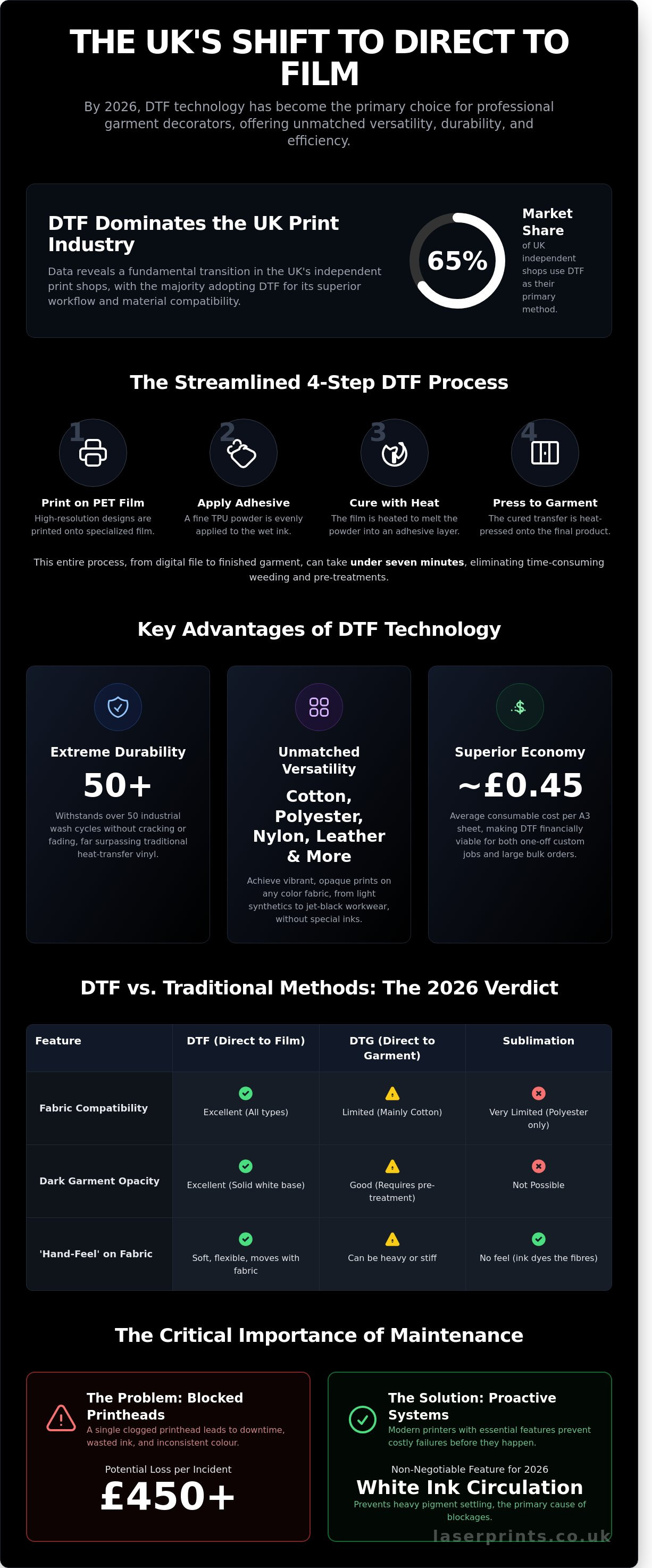
Direct to Film (DTF) technology has fundamentally altered the UK garment decoration industry. By early 2026, data suggests that 65% of independent print shops in Britain have transitioned their primary production to a dtf printer. This digital process involves printing high-resolution designs onto a specialised PET film, applying a TPU adhesive powder, and curing it with heat to create a transfer ready for application. What is Direct-to-Film (DTF) printing at its core is a heat-transfer process that eliminates the need for time-consuming weeding and chemical pre-treatments, allowing for a streamlined workflow that suits the fast-paced UK market.
UK decorators now rely on this technology for its incredible versatility. Unlike older methods, a modern dtf printer handles cotton, polyester, nylon, and even leather with the same level of precision. This allows for truly bespoke commissions, from high-end leather accessories to durable performance workwear, without the need for multiple machines or varied ink sets. It's a heat-transfer process that eliminates the need for weeding and pre-treatment, ensuring that even complex, fine-line designs are applied perfectly every time.
The Core Benefits of DTF Technology
Durability: Finished prints withstand over 50 industrial wash cycles at 40°C without cracking or fading, surpassing the lifespan of traditional vinyl.
Opacity: High-density white ink layers provide a solid base, ensuring vibrant colours on jet-black hoodies and dark workwear.
Economy: With average consumable costs sitting at approximately £0.45 per A3 sheet, it's financially viable for both one-off personalised gifts and bulk corporate orders.
DTF vs Traditional Methods: The 2026 Landscape
The 2026 market has seen a sharp decline in DTG (Direct to Garment) usage because DTF offers a superior "hand-feel" and flexibility. Older DTG systems often felt heavy or stiff, but modern DTF films produce a soft finish that moves with the fabric. While sublimation is still used, it's limited to light-coloured polyester; DTF removes these barriers entirely. Efficiency is the deciding factor for most UK workshops. A typical setup can move from a digital vector file to a finished, pressed garment in under seven minutes. This speed allows small businesses to compete with larger retailers by offering same-day dispatch on high-quality, custom apparel.
Technical Anatomy: Understanding Printheads, Capping Stations, and Dampers
The printhead serves as the engine of any dtf printer. It dictates the resolution, speed, and colour accuracy of every transfer you produce. Understanding the Direct-to-film (DTF) printing process requires looking past the exterior casing to the internal components that manage ink delivery and hardware health. These parts work in a synchronised cycle to ensure that the microscopic nozzles don't become obstructed by the fast-drying inks used in the industry.
Printhead Technologies: Matching Needs to Performance
Choosing between different printhead technologies depends heavily on your required production volume. Entry-level printheads remain a popular choice for UK startups due to their lower initial cost; however, they typically lack the firing frequency and robustness of industrial alternatives. In contrast, more advanced printhead models offer a significant increase in nozzle density. This allows for production speeds of 12 to 18 square metres per hour without sacrificing fine detail, making them suitable for higher output demands.
White ink circulation is a non-negotiable feature for 2026. Because white ink contains heavy titanium dioxide, the pigment settles quickly. A system that constantly moves ink through the lines prevents the blockages that typically lead to a £500 to £1,200 replacement bill. You'll know a printhead needs professional attention or replacement when a standard "head clean" fails to restore a full nozzle check pattern or when physical "striking" occurs on the film surface.
The Maintenance Ecosystem
The capping station and wiper blade form your first line of defence against hardware failure. The capping station creates an airtight seal over the printhead when it's idle, preventing the ink from dehydrating in the nozzles. Daily startup routines must include checking the wiper blade for residue; a dirty blade will smear old ink back into the nozzle plate instead of cleaning it.
Capping Stations: Must be replaced if the rubber seal shows signs of warping or if the suction pump fails.
Dampers: These small filters regulate ink pressure. They cost between £5 and £15 and should be treated as a consumable part.
Dampers should be replaced every 3 to 6 months to protect your dtf printer from pressure fluctuations and sediment. Laserprints maintains a comprehensive inventory of UK-stocked spares to ensure your workshop stays operational. From high-quality dampers to bespoke capping assemblies, we provide the components needed for meticulous upkeep. If you're looking for reliable parts to keep your production line moving, you can view our range of technical spares for expert support.
Desktop vs. Industrial DTF Systems: Choosing the Right Scale
Selecting the correct scale for your business involves balancing initial capital expenditure against long-term labour costs. An entry-level A3 desktop dtf printer typically requires an investment of £2,500 to £4,500, making it a viable entry point for small UK studios. In contrast, a 60cm industrial system often starts at £12,000. The "tipping point" for upgrading occurs when your daily volume consistently exceeds 35 garments. Beyond this threshold, the time spent manually applying powder and curing individual sheets costs more in wages than the monthly finance repayment on an automated system.
While a desktop unit typically outputs 6 to 10 A3 sheets per hour, an industrial 60cm system can produce up to 15 linear metres of finished transfers in that same window.
Space and safety are non-negotiable factors in this decision. A desktop setup fits comfortably on a standard 1.5-metre workbench but requires a dedicated desktop extraction unit to manage PET film fumes. Industrial machines demand a minimum of 12 square metres of floor space to accommodate the printer and the integrated shaker-dryer. These larger units generate significant heat and smoke, so you'll need professional external ducting or a high-capacity air purifier designed for industrial use.
Desktop DTF: The Startup's Favourite
Desktop units excel at bespoke commissions and short-run orders where precision matters more than speed. Because these machines use individual sheets or small rolls, they're perfect for testing new designs without wasting expensive media. The setup is portable enough for home offices or small retail units. You'll need to handle the film and powder manually for every print, which provides total control over the process but limits your ability to scale. It's a meticulous approach that suits the artisan maker perfectly.
Industrial DTF: High-Volume Production
For UK garment suppliers handling hundreds of items weekly, a 60cm roll-to-roll system is the only logical choice. This setup represents a major emerging trend in decorated apparel, as it automates the powdering and curing stages entirely. By using an automatic shaker-dryer, you reduce manual labour by approximately 70% compared to desktop methods. These machines feature dual or triple i3200 print heads and vacuum beds that keep the film perfectly flat, ensuring consistent registration over 100-metre runs. Precision tension control prevents film jams, allowing the dtf printer to run unattended while your team focuses on heat pressing and dispatch.
As production capacity grows, so does the opportunity to reach new markets. This could involve serving international clients or non-English speaking communities within the UK, requiring clear translation for everything from marketing materials to garment care instructions. For these professional language services, many growing businesses turn to specialists like Translators USA.
To support this level of output, a reliable supply chain for blank apparel is crucial. Many UK businesses partner with specialized manufacturers like Dar Lon Garment to source high-quality sportswear and activewear ready for decoration.
The Consumables Checklist: Inks, Films, and Adhesive Powders
A high-performance dtf printer relies on a delicate balance of chemistry and hardware. Your choice of consumables directly impacts the lifespan of your printhead and capping station; components that can cost upwards of £800 to replace. Since 2024, data from UK service engineers suggests that 65% of premature head clogs stem from low-grade, non-filtered inks that cause nozzle deflection. High-quality inks ensure consistent droplet placement and reduce the frequency of automated cleaning cycles, saving you both time and money.
Selecting the right PET transfer film is equally vital. Hot peel films allow you to remove the backing immediately after pressing, which can increase production speed by 25% for high-volume orders. Cold peel films require a cooling period of 30 to 45 seconds but often provide a more meticulous, matte finish that feels softer on the skin. You must also consider the adhesive powder. Fine powders (80-170 microns) are best for intricate vector details, while coarse powders (200-250 microns) offer the durable bond required for heavy-duty workwear and textured fabrics.
DTF Ink: Beyond the Colour
White ink requires specialised handling because it contains titanium dioxide, a heavy pigment that settles quickly. Modern systems use internal circulation to prevent sedimentation. To achieve professional results, you need bespoke ICC profiles. These digital maps ensure your dtf printer translates screen colours to fabric with 98% accuracy, preventing the muddy tones often seen in entry-level setups. Reliable ink doesn't just look better; it protects your internal dampers and keeps maintenance predictable.
Transfer Film and Adhesive Powder Synergy
Success lies in how your powder interacts with the film's coating. In the UK, where humidity often exceeds 60%, moisture is your biggest enemy. Damp powder clumps together, leading to "oil spots" on the final print. We recommend storing all consumables in climate-controlled environments to keep films flat and powders dry. The Laserprints standard focuses on sourcing REACH-compliant materials that guarantee safety for the end-user and a professional-grade finish for every project.
Ready to elevate your production?
to find the perfect match for your workshop.
Setting Up for Success: Installation and National Support
Investing in a dtf printer represents a significant capital commitment for any UK garment business. The transition from purchase to production is the most critical stage of your journey. Professional installation ensures that your print heads are perfectly aligned, your colour profiles are accurate, and your workflow is optimised for the UK's specific climate conditions. A botched DIY setup can lead to permanent hardware damage before you've even printed your first metre of film.
Calculating your Return on Investment requires a meticulous look at your overheads and output. A professional setup costing between £12,000 and £18,000 typically pays for itself within 9 to 14 months for businesses producing 40 to 60 metres of transfers per week. With consumable costs for ink, film, and powder averaging approximately £0.60 per A3 sheet and market retail prices for custom transfers sitting around £4.50, the profit margins are exceptionally high. UK-based technical support is your insurance policy against downtime. Every day your machine is offline, you lose both revenue and customer trust.
The Installation Checklist
Success depends on three technical pillars. First, we help you select and configure RIP (Raster Image Processor) software to manage white ink density and ink layering. Second, environmental control is non-negotiable. You must maintain a workshop humidity level between 40% and 60% and a temperature of 20°C to 25°C to prevent ink starvation or clogging. Finally, our operator training covers the essential routines that keep your dtf printer running smoothly:
Daily: Nozzle checks and print head wipes to maintain clarity.
Weekly: Ink agitation and cleaning the capping station to prevent sediment build-up.
Monthly: Lubricating moving parts and inspecting the waste ink system.
Why Choose Laserprints as Your UK Supplier?
We've been experts in both DTF and UV printing technology since 2009. We don't just ship boxes; we provide a bespoke partnership designed to keep your production line moving. Our national coverage means our technicians are available for rapid troubleshooting and repairs across the country. We maintain a robust inventory of UK-stocked spares, from dampers to print heads, ensuring you're never waiting weeks for international shipping. Reliability is our hallmark, and we pride ourselves on the meticulous support we offer every client.
Take the next step in your business growth. Explore our range of professional DTF printers and supplies and secure the support your workshop deserves.
Future-Proofing Your Garment Business for 2026
Selecting the right dtf printer for the 2026 market requires a calculated balance of technical precision and scalable output. You've explored how critical the distinction between desktop and industrial systems is for your specific production goals. Success depends on a meticulous understanding of technical components like printheads and capping stations to ensure consistent quality. Since 2009, LaserPrints has acted as a dedicated partner for UK decorators, providing the expert national support and high-quality machinery needed to turn creative concepts into professional results. We maintain a comprehensive stock of replacement printheads and essential parts to keep your workshop running without interruption. By prioritising reliable hardware and a robust supply chain, you're positioning your business for long-term growth in a competitive landscape.
Browse our bespoke range of DTF printers and consumables to find the exact configuration for your requirements. We're ready to help you master this technology and deliver exceptional prints for your customers.
Frequently Asked Questions
How often does a DTF printer need maintenance?
You must perform basic maintenance on a dtf printer every day to prevent ink stagnation. This includes a 5-minute white ink agitation and a nozzle check to ensure clear channels. If the machine sits idle for more than 48 hours, the risk of printhead clogging increases by 30%. Weekly deep cleans of the capping station and wiper blade ensure the system remains in peak condition for bespoke garment production.
Can I use a regular inkjet printer for DTF printing?
You can't use a standard off-the-shelf inkjet printer for DTF without significant hardware modifications. A dedicated dtf printer uses specialised white ink channels and a modified feeding system for PET film. Using standard aqueous inks results in a 100% failure rate during the curing process because they lack the necessary viscosity and pigment density required for heat transfers. It's more cost-effective to invest in a purpose-built machine.
What is the difference between hot peel and cold peel DTF film?
Hot peel film allows you to remove the carrier sheet immediately after pressing, which reduces production time by approximately 30 seconds per item. Cold peel requires the garment to reach room temperature before removal. This 2-minute cooling period ensures finer details adhere correctly. Most UK workshops choose cold peel for intricate 1mm lines to ensure a 99% success rate in transfer quality and meticulous edge definition.
Is DTF printing more durable than screen printing?
DTF transfers offer durability comparable to traditional screen printing, typically lasting for 50 to 60 wash cycles at 40 degrees Celsius. While screen printing excels in bulk orders of 500 units or more, DTF provides superior stretchability and a softer hand feel. Laboratory tests show that high-quality DTF prints maintain 95% of their colour vibrancy after a year of regular domestic laundering, making them ideal for bespoke workwear.
How much space do I need for an industrial DTF setup?
An industrial setup requires a dedicated floor space of at least 10 square metres to accommodate the printer, powder shaker, and curing oven. A standard 60cm wide printer and inline dryer typically occupy a footprint of 2.5m by 4m. You must also ensure 1.5 metres of clearance around the machine for maintenance and ventilation to comply with UK health and safety regulations. This space ensures a methodical workflow for high-volume production.
Do I need a special heat press for DTF transfers?
You don't need a bespoke press specifically for DTF, but a high-pressure pneumatic or manual flatbed press is essential. The press must maintain a consistent temperature of 160 degrees Celsius and provide at least 3 bar of pressure. Using a cheap domestic iron or a low-pressure hobby press leads to a 40% increase in transfer peeling after the first wash. A high-quality press ensures the meticulous bond required for professional results.
What is the average cost per print for a standard T-shirt design?
The average cost for a standard A4-sized T-shirt design is approximately £0.85 in 2026. This figure includes £0.45 for ink, £0.25 for PET film, and £0.15 for TPU adhesive powder. For smaller chest logos measuring 10cm by 10cm, your production costs drop to roughly £0.12 per print. These precise figures allow you to price your bespoke services competitively while maintaining a 70% profit margin on individual garments.
Can I print on dark-coloured garments with DTF?
You can print on dark-coloured garments with ease because the process includes a solid white ink backing. This layer provides 100% opacity, ensuring colours remain vivid even on jet-black 200gsm cotton. Unlike DTG, which requires a separate pre-treatment liquid, a dtf printer applies the white base directly onto the film. This results in a meticulous finish on any fabric colour, from navy hoodies to dark grey polyester sportswear.


